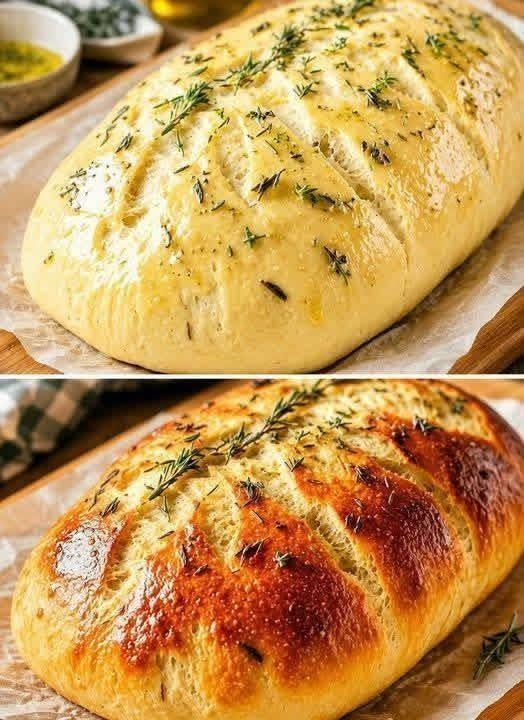
This homemade herb bread has a soft, fluffy interior and a beautifully golden, slightly crispy crust, just like the bread in your picture. It’s infused with olive oil, garlic, rosemary, thyme, and parsley for a fragrant, savory flavor.
It’s perfect alongside soups, pasta, salads, grilled chicken, or simply served warm with garlic butter.
Recipe details
Prep time
20 minutes
Rising time
1–1½ hours
Baking time
25–35 minutes
Yield
1 large loaf
1. Ingredients

For the bread dough
- 3½ cups (420–450 g) all-purpose or bread flour
- 1 cup (240 ml) warm water, about 38–43°C (100–110°F)
- 2¼ teaspoons (7 g) instant yeast
- 1 tablespoon sugar or honey
- 1½ teaspoons salt
- 2 tablespoons olive oil
- 2 tablespoons plain yogurt, optional, for a softer crumb
For the garlic herb topping
- 3 tablespoons olive oil or melted butter
- 3–4 garlic cloves, finely minced
- 1 tablespoon fresh rosemary, finely chopped
- 1 tablespoon fresh thyme leaves
- 1 tablespoon fresh parsley, chopped
- ½ teaspoon dried oregano, optional
- A pinch of black pepper
- A little flaky salt, optional
For brushing
- 1 tablespoon olive oil or melted butter
- A little extra chopped rosemary or thyme
2. Step-by-step instructions

Step 1: Activate the yeast
Combine the warm water, sugar, and yeast in a small bowl. Leave for 5–10 minutes if using active dry yeast, until foamy.
If using instant yeast, you can mix it directly with the flour instead.

Step 2: Make the dough
Mix the flour and salt in a large bowl. Add the yeast mixture, olive oil, and optional yogurt.
Stir until a rough dough forms. Knead for 8–10 minutes by hand, or 5–7 minutes in a stand mixer, until smooth and elastic.
If the dough feels dry, add water a teaspoon at a time. It should be soft and slightly tacky, not stiff.

Step 3: Let the dough rise
Place the dough in a lightly oiled bowl, cover, and leave in a warm place for 60–90 minutes, or until doubled in size.
Rising time depends on the temperature of your kitchen.

Step 4: Shape the loaf
Gently press the dough to release excess air. Shape it into a large oval loaf and place on a parchment-lined baking tray.
Cover loosely and let rise for another 20–30 minutes. Meanwhile, preheat the oven to 190°C (375°F).

Step 5: Prepare the herb topping
Mix the olive oil or melted butter with the garlic, rosemary, thyme, parsley, oregano, and black pepper.
Make 4–5 shallow diagonal slashes across the loaf using a sharp knife. Brush the herb mixture over the top, allowing some to enter the cuts.

Step 6: Bake until golden
Bake for 25–35 minutes, until the crust is deeply golden and the loaf sounds hollow when tapped underneath.
If the bread browns too quickly, loosely cover it with foil. For food safety, the center should reach approximately 93–96°C (200–205°F).

Step 7: Brush and cool
Brush the hot loaf with a little olive oil or melted butter. Add a few fresh herbs if desired.
Let it cool for at least 20 minutes before slicing so the inside stays fluffy and does not become gummy.
3. Nutrition information
Estimated nutrition per slice, assuming 12 slices from one loaf and the optional yogurt is omitted.
| Nutrient | Per slice |
|---|---|
| Calories | 155–185 kcal |
| Protein | 4–5 g |
| Carbohydrates | 27–31 g |
| Total fat | 3–5 g |
| Fiber | 1–2 g |
| Sugars | 1–2 g |
Values depend on the flour, amount of oil or butter, and slice size.
4. Complete nut information and allergy guide
This garlic herb bread recipe does not require nuts.
- Peanuts: not intentionally included.
- Tree nuts: not intentionally included.
- Wheat and gluten: present in regular flour.
- Dairy: optional yogurt and butter contain milk; olive oil can be used instead of butter.
- Soy: some packaged flour products or baking ingredients may have cross-contact warnings.
For a nut-free kitchen, check ingredient labels and use clean equipment if preparing the bread for someone with a nut allergy.
5. Tips for the perfect herb bread
- Use warm, not hot, water: excessively hot water can damage the yeast.
- Knead sufficiently: a smooth, elastic dough gives the bread a soft texture.
- Don’t add too much flour: a slightly tacky dough usually produces a lighter loaf.
- Use fresh herbs when possible: rosemary and thyme provide the aromatic flavor shown in your picture.
- Don’t let garlic burn: fresh minced garlic can become bitter if exposed to excessive heat. If your oven browns the topping quickly, add some of the garlic-herb oil partway through baking.
- Score the loaf before baking: diagonal cuts help the bread expand and create an attractive rustic appearance.
- Cool before slicing: cutting immediately can compress the crumb.
6. Frequently asked questions (Q&A)
Q1. Can I use dried herbs instead of fresh herbs?
Yes. Use about one-third the quantity of dried herbs because they are more concentrated. For this recipe, start with 1 teaspoon dried rosemary and 1 teaspoon dried thyme.
Q2. Can I make the dough without yogurt?
Absolutely. The yogurt is optional. The bread will still be soft if you knead it properly and avoid adding too much flour.
Q3. Can I use whole-wheat flour?
Yes. Replace up to half of the all-purpose flour with whole-wheat flour. You may need a little extra water, and the bread will be denser.
Q4. Why didn’t my bread rise?
The yeast may be expired, the water may have been too hot or too cold, or the room may have been too cool. Keep the dough covered in a warm, draft-free place.
Q5. How do I get a crispier crust?
Preheat the oven thoroughly and bake until the loaf is deeply golden. You can place a small oven-safe dish of hot water in the oven during the first 10 minutes to create steam, provided your oven manufacturer permits it.
Q6. Can I add cheese?
Yes. Add ½ cup grated Parmesan or mozzarella to the dough, or sprinkle Parmesan over the loaf during the last 10 minutes of baking.
Q7. Can I make individual herb rolls instead?
Yes. Divide the dough into 8–10 pieces, shape into rolls, allow them to rise, and bake at 190°C (375°F) for approximately 15–20 minutes.
Q8. How should I store homemade herb bread?
Once completely cool, store it in an airtight bag or container at room temperature for about 2–3 days. Avoid refrigerating it, as refrigeration can make bread stale more quickly.
Q9. Can I freeze this bread?
Yes. Cool completely, wrap tightly, and freeze for up to 2–3 months for best quality. Thaw at room temperature and warm in the oven before serving.
Q10. Can I make it without sugar?
Yes. The small amount of sugar helps yeast activity but is not essential with instant yeast. You can omit it, though the dough may rise more slowly.
Q11. Can I prepare the dough ahead of time?
Yes. After kneading, cover the dough and refrigerate overnight. Let it warm up and finish rising before shaping and baking.
Q12. What meals go best with garlic herb bread?
Serve it with tomato soup, creamy mushroom soup, pasta, lasagna, roasted vegetables, grilled chicken, or a fresh Mediterranean salad.
7. Delicious variations

Rosemary and olive oil bread
Use extra rosemary and olive oil for a fragrant Mediterranean-style loaf.

Cheesy Parmesan herb bread
Add grated Parmesan to the topping for a savory, cheesy crust.

Garlic butter bread
Replace the olive oil topping with melted butter, garlic, and parsley for a richer flavor.
My recommendation: For the loaf in your picture, make a soft oval dough, score it diagonally, brush it generously with garlic, olive oil, rosemary, and thyme, then bake until the crust is golden brown. Serve warm with olive oil for dipping or alongside your favorite pasta dish. 🌿🍞